Showing posts with label Hillary Clinton. Show all posts

Saturday, March 5, 2016

My Political Tidal Rage

It feels like it's been a long time since I've completed a post on this blog. I've tried to start new posts up, I promise. You see, I would start writing and then realize that I had
gone off the reservation. Here's what I mean by that. Anything that's worth writing about right now (and there's so much that is worth it) genuinely begins to make me angry when I start writing. I veer off, get a little bit partisan/spiteful/personal. I lose the tone that I'm trying to maintain.

The truth is that this election is bringing out the intellectual worst of me.

I think we all look around and see the most ridiculous spectacle in politics that we've seen in at least one, if not two, generations. Listening to CSPAN earlier, a guest equated the current insurgency on both sides to the Goldwater insurgency in the 60s. Interestingly enough, I do see a bit of truth in that. Similar to now, a counter-establishment candidate came along and riled the people up. Before the establishment knew what was happening and realized this was a serious threat, it was too late and Goldwater became the inevitable nominee. It was stated that the night Goldwater became the nominee for the GOP was the beginning of the 'modern era' of the Republican party, that is until now.

Donald Trump's rise and momentum is analogous to the movement 60 years ago, but Goldwater is certainly no where near the character that Donald Trump is. He certainly never had the luxury of social media and a 24/7 news cycle either. This leads us to the advent of the new Republican party, a marriage between populism and a persistent media with an injection of rabid anger. Things will be getting strange for the Party's elites for the remainder of this election cycle and the next few congressional cycles too until this new movement figures itself out.

Donald Trump is a bipartisan product that was conceived from a toxic environment of stagnation, political polarization, and a frustrating lack or results. I say again, a BIPARTISAN product. This is not solely the fault of the President's party or the controlling party in Congress. Their inability to work for America forced the American people to find the most disruptive candidate that gave the best chances for a hard reset they so desperately desired.

Now, on the Democratic side, that counter-establishment candidate in Bernie Sanders is fading but not gone. The Establishment will likely win out and award Hillary Clinton the nomination. While Sanders will not likely be in the national political conversation for many more weeks or months, his impact and the challenging of the status quo will certainly linger and be ever-present in the Democratic Party for some time, which will likely force any front-runner further to the Left to maintain support.

So, this is where we're at. I wrote a piece called the Hoberman Sphere Cycle, which argued that parties' candidates will expand out to the poles to win over the support of their party but contract back to the center during the General election. I'm not backtracking from that completely, but the current trajectory is not kind to my analysis. My hope is that both Mrs. Clinton and Mr. Trump make a very delicate dance back to the center, but their tidal wave of support is currently built on rage. It is a rage that symbolizes the entire 2016 election cycle and a rage that has been built to such a burning fury over the past several months that I doubt there is a legitimate means to quell the flames and return civility to the discussion.

Let's face it. As citizens and voters, we have been dealt a horrible hand this year. On the Republican side, the remaining legitimate contenders are a reality TV star/business mogul with overly questionable character attributes. There is a Texas Senator that has changed his position more times on key issues over the last several years than I care to count and has no friends in Congress Then there is a Florida Senator that cannot show up to work and doesn't have enough of an 'it factor' to be many peoples' first choice.

On the Democratic side, we have a bona fide socialist that, while well-intentioned, is completely out of his element and is largely a single-issue candidate. Then there is a candidate who is synonymous with scandal, questionable decision-making, and lacks an ability to be consistently honest.
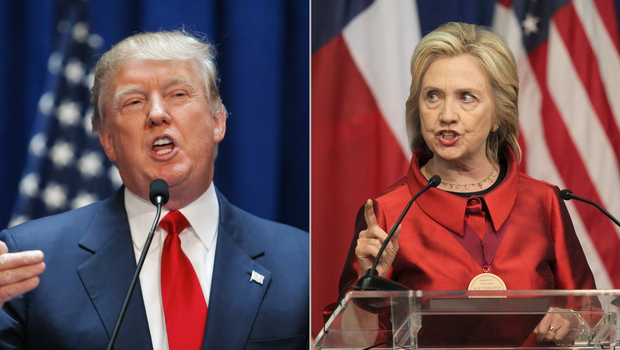
This is what we have to work with. No wonder the anger is at a fever pitch in this country. We deserve better than this, we truly do. For months, the candidates have not even engaged in true policy discussions. Instead, there has been the same type of bickering and toxicity that is the cornerstone of the same Federal leadership and system the country has grown to abhor. So, even when we hope for something new, all we get is more of the same.

Truthfully, a third-party candidate would not solve this, it might even make it a more contentious and splintered environment. So, we need to work with the team we have right now.

I have always hated highlighting problems without providing a solution to consider. Yet, here I am, doing just that. I don't know what the solution is. It can't just suffice to tell the respective parties to 'do better', but I find that I'm a critical hope deficit at the moment. That is painful.

APN readers, I don't recognize my country right now, but it needs to go find itself in a hurry.

Tuesday, February 16, 2016

A Super Election Day Revolt

As messy as things are for the Republican field in the primary election, the Democrats are possibly facing General Election day woes in November. Hillary Clinton and Bernie Sanders are getting an enormous amount and support from the different corners of the party. I'm not yet comfortable saying that this is an unprecedented amount of enthusiasm (because 2008 was at a fever pitch), but the level of emotion right now is certainly epic.

With the enthusiasm of high emotion comes the decision-making of high emotion, and this emotion that the Democrats have channeled is poised to backfire in November.

As has recently been making the political headlines, Bernie Sanders and supporters are pushing back hard against the current system that pits Clinton far ahead of him in the all-important delegate count for the party's nomination. Of course, it would make sense that with Sanders' narrowest of losses in Iowa and dominance in New Hampshire, that he should be enjoying a comfortable lead going into a South Carolina that he will likely lose by 15+ points. But there's a catch: superdelegates. The superdelegate deficit for Sanders truly has an insurmountable appearance to it.

These superdelegates are essentially un-pledged delegates that are free to support any candidate of their choosing regardless of the outcome of their state's primary. They are most commonly in this role based on status (even former status) as an elected party official or leader, though there are still un-pledged delegates that have not held office and were selected by state party officials.

Here's the situation, before a single Nevada vote is cast and with a surge of momentum propelling Sanders forward he is still behind Clinton by 350 delegates, the great abundance of which are pledged superdelegates. Not to mention, before another single vote is cast, The Hill reports that Clinton has already secured the support of half of the superdelegates in Nevada and South Carolina, furthering her lead before the democratic process can occur.

No doubt an awesome weapon for Clinton to have in her back-pocket as the head-to-head polls show a slimming national lead and significant public backing escalating for Sanders in other earlier primary states. As this race intensifies, this voting block could be the extra power that the Clinton campaign needs to secure the nomination. Of course, superdelegates are not pledged until the nomination, but the unofficially declared support from these individuals is the current political reality.

Herein lies the problem. Let's go back to what I said earlier on here, this is a time of high emotion within the Democratic electorate. Bernie Sanders has built a mega-stable of support among the voters that feel out of touch with the system and those that see a government and 'ruling class' that has abandoned them.

Sanders has built an entire campaign on promising to make things fair again for those that the system is unfair to.

So, what does it mean when (per the last national poll) 42% of the Democratic voters feel that their efforts have been marginalized by an Establishment and its rules that void out their votes and opinions? What would be the expected reaction of a large base of people that so whole-heartedly buy into a message from a politician, in a time when politicians are outcasts, a politician that people finally feels care about them?

I submit to you that the reaction would be a very emotional one and would come in two forms in November.

First, the Sanders supporters could very possibly just decide to vote with their feet as a protest against the entire political machine. Historically, this is one of the most symbolic forms of election day protest and could be the refuge of millions of disenfranchised Democrats. Sanders says it himself. When voter turnout is high and people are energized, Democrats win elections. When the people are demoralized and they do not turn out, Republicans typically win. Now, I can't necessarily speak to how true or not that statement is, but perception is reality. The perceptions then among a demoralized base for Sanders could then very possibly be not to show up in November.

An alternative, albeit exponentially less likely, is that the Sanders supporters opt to take the fight to Clinton and the Democratic Establishment in November and vote for the opposition as a sign of protest. Is this possible, sure. However, I still believe that the party would find a way to unify before this happens, but for an emotional base, this would also be an emotional reaction.

All of this to say, that if you are sitting in a leadership role in the DNC and across State parties, it might be time to consider how superdelegates come into play this early in the process. Sanders supporters are already on fire about how this is perceived to be used against them. Easing this now as a point of tension will likely pay dividends at the ballot box in November. With head to head election polls showing razor thin leads, depending on the match-up, a candidate can't afford to be at a loss for votes that they ought to be able to rely on. If the GOP field gets synchronized against the Democrats, November could prove to be a dark time for the Democrats as the people engage in an Election Day Revolt.

Tuesday, February 9, 2016

The Swamp Got Murkier?

The New Hampshire Primary does not have a precision-riddled history. In fact, the New Hampshire results consistently do very little for predicting the ultimate winner of the two parties' nominations. Though the 'First in the Nation' primary has a bet of a better track record than the Iowa Caucus, this just isn't the pressure gauge to make any sort of long-term judgement by.

If you look at each party's primary dating back to 1980 (excluding unopposed runs), the Granite State primary has only had a 9/14 accuracy, that's a 64% accuracy rate. Arguably though, since 2000, the New Hampshire primary has been much more accurate than since 1980, but all trends rely on history and many, many data points. That being said, I'm not putting much stock into what the primaries tonight mean for either party.

So, you ask, what do the primaries do? What's the point then?

Politically speaking, there are significant primary and secondary order effects, potentially much more so for the GOP than the Democratic field. With regard to Republicans, there are two factors that come into play when the results are finalized: momentum and the culling of the herd. Momentum was all of the post-Iowa talk. We heard about the bull market on Marco Rubio and Ted Cruz and the bear market on Donald Trump and the three establishment candidates.

Obviously, this market trends in all directions at all times as we saw with Marco Rubio's stifled #Marcomentum post-Saturday's debate and John Kasich's seemingly steady climb toward the top of the second tier when he was never awarded a single delegate in Iowa. As we scream (or crawl) closer to the respective conventions, the next wave of momentum for the insurgents and the establishment will be key for anyone's long term viability.

On that matter of long-term viability, the New Hampshire primary also has the historical effect of culling the herd....historically. 2016 may very well be an exception with all 11 candidates that entered tonight (yes, even Gilmore) on the road to South Carolina. That aside, textbooks tell us that the field ought to be whittled down by a candidate or two, which means that you have brand new, undeclared voters that are just looking for a new home. This type of open capital puts candidates into a free-for-all to vie for the affections of these newly available supporters. Depending on who drops out (Fiorina? Christie? Carson?) that opens up a lot of people that swing the balance of the primary in a major way.

On the Democratic side, there's obviously going to be no culling of any herd. You have two candidates, and you're going to have two candidates until the winning delegates total is reached by one of them. Again, this comes back to the momentum argument. By all accounts (pre-results), Sanders ought to win the primary, but now this is where the expectations game comes into play.

There is a chance that Bernie Sanders blows his shot at the nomination tonight even if he wins. Expectations going back to just last week had the Vermont Senator sitting at a comfortable, victory formation distance. In the last week, polls show that Hillary is closing that gap. Now again, probably not enough to win, but she sets herself up very well going forward if the loss is in the low to mid single digits. She beat expectations and completed an effort to make her the second Clinton 'Comeback Kid'.

On the other hand, New Hampshire feels the Bern, we have a long race ahead of us, America.

There's a good chance that tonight's election does us no favors, but isn't that the fun of watching all of this? Politics itself is not a spectator sport, but being a spectator at this juncture is all the rage to me.

Sunday, February 7, 2016

The Hoberman Sphere Cycle

Do you remember that kids toy from years and years ago that was basically this big ball that could be expanded and contracted? Google told me that it was called a Hoberman Sphere. More importantly, why would I even possibly be thinking about a Hoberman Sphere? The truth is that I've been trying to think of the perfect analogy to address what the American electorate is experiencing out of all of the candidates this season thus far (and really many, many seasons before too).

Much like Hillary Clinton, most candidates aim to start out there campaigns by positioning themselves as the moderate option in their party, the most appealing candidate that can be the collective solution to uniting the party and then America. There's a hiccup in that plan though...the rest of the candidates in the field.

My time in the political campaign world taught me something pretty obvious: the most energized people will always come out and vote in the primaries. Almost without fail, the most energized people are the people that occupy the more conservative pole (for Republicans) and more liberal pole (for Democrats) of their party. The people that occupy the poles often espouse very passionate views that are outside the moderate wings of their parties.

We were taught to target the people that were thought to be within that realm. They were targeted for donations, notional support, and even yard signs. Why? They were just the more likely people to agree because it meant that someone on the ballot would be in alignment with them when not really too many other candidates on the ballot had strayed away from the moderate faction of their party.

This means that many moderates in the party were not as routinely sought after, but, then again, the moderates were often very indecisive about their candidate choice and thus non-committal to a campaign because the field would be so crowded with candidates in the middle of the spectrum. So, over time, the moderates get left behind, as other candidates look to capitalize on the same amount of momentum and support that others are having by moving toward the more 'extreme' poles of their party.

Another key reason why there is this move to the poles (and we saw this at the Iowa Caucus and into New Hampshire and other early primaries) is to tap that energy into the poles and translate that into voter turnout. A lapse in voter turnout in a candidate's favor typically spells the end of the campaign and the hopes of that candidate. So, during the primary season, that's why we often see much more extreme rhetoric than what we might be accustomed to seeing when two candidates are squaring off against each other in the general election.

Once a candidate secures their party's nomination, the process begins to rollback many of the primary election pledges and stances that propelled a candidate to the front of the pack. Now what happens is the complete inverse (the contraction of the Hoberman Sphere). Party loyalists are invested, so it becomes a war for the independents and moderates of the opposing party. We now start to hear the media coverage of the battle for independents, who now become the key demographic in the general election.

Perhaps I'm being naive or optimistic, but there is a lot of alarm sounding around the country that our politics is more divisive than ever. Arguably, it's still divisive, but the problem might not be as dire as is being portrayed. Much of what we're seeing right now is over-reaction to what is still largely typical for the primary campaign season, albeit very atypical personalities that fuel the overall concern.

Of course, the sphere semi-expands again during the general election, though the tension is not aimed within the party. Candidates go into full-court press to do two things: make greater strides to move their platform to the middle and argue that their opponents is far extreme of the broader American electorate.

So, keep calm for now, readers. We're just along for the ride inside of a continuous, age-old political loop. The only way to exercise some measure of control it is by try and control who sits in the Oval Office.

Let me know what you think! Please comment and/or share!

Thursday, February 4, 2016

Not What It Looks Like

The Republicans are often under siege for waging a war against women and are commonly on defense over gender equality. However, on appearances, the party has long been pegged as the party for old white men. In recent years though, the party has been trying to make strides to improve perceptions. Going back the past two election cycles, the GOP has featured candidates such as Michelle Bachmann and Sarah Palin (as Vice President). This specific cycle is teasing out the potential inclusion of Governor Nikki Haley on the GOP ticket.

That brings us to Carly Fiorina.

Ever since announcing her candidacy, she has endured a roller-coaster ride between the lower and middle tiers of the Republican field, made headline news feuding with Donald Trump, and has generally stood her ground on every matter that has crossed her. Yet, she hasn't been able to catch fire and make a sustained run at a top-tier position.

Now, we have a conundrum. The lower-tier candidates have begun dropping out post-poor performances at the Iowa Caucus, but there are too many candidates for the main stage and not enough for the lower card debate. What this now unfortunately means for Mrs. Fiorina is that she's left without a stage as the candidate currently at the low end of the totem pole.

Everyone involved is acting 100% in accordance with the rules of the debate stage, but one almost needs to pause to ask if this is truly the wisest move for the Republican party. While it's certainly 'not what it looks like', the appearance is that the GOP is kicking the only woman in the race in their party to the curb. Perhaps in other years it might not be such a faux pas, but when the leading candidate in the opposing party is a woman, it certainly hurts any bona fides the party might be trying to establish.

Mrs. Fiorina would make the eighth participant on the debate stage on Saturday night, and the GOP has certainly showcased more candidates than that in previous debates. Of course though, it is more than likely that even a strong performance on the debate stage this weekend would yield negligible positive results for her. That's not the point.

The GOP can't afford any slip-ups that leave voters seeing them as unfair to women, especially as the general election comes up and the Republican ticket is probably pitted against Hillary Clinton. The notable exclusion of Carly Fiorina is truly not so egregious, but it's but another nail in the fence that holds back a broader base of women's support to the GOP.

In an another election that is likely to be so close (based on current head to head polls), any actions to estrange a constituency is simply bad for business for the Republican party.

Ultimately, there is no blow-back on the GOP and it helps mend the current public scourges against the party for excluding the only woman in the race on this side. Putting her back on the stage takes away minimal air time from the more main-stream candidates and alleviates the distraction that could likely be a factor in the social media realm during the debate.

Narrowing it down a little further, this is the morally correct thing to do. For so many candidates, next Tuesday will be the end of the road and everyone deserves the chance to make a very public final pitch. To deny that opportunity is contrary to American democratic principles. The GOP's best move is to reverse course and allow Mrs. Fiorina to participate this weekend. It might be the only play.

Sunday, January 31, 2016

Is America's Glass Ceiling Shatter-Proof?

In the lead-up to the GOP Debate on Thursday, a thought that I had buried away months ago aggressively returned as the attacks surged against Megyn Kelly. While I make no claim of support on her feud with GOP candidate Donald Trump, it is certainly difficult to ignore the enormous tidal wave of negativity that was predominately thrown her way. What ought to be even more difficult to ignore is the type of negativity she encountered. Regardless of where one leans on the issue that caused Mr. Trump to skip the debate on Thursday, it certainly feels more than fair to say that many have lost (or perhaps never had) the ability to maintain civility.

You can find the evidence on any social media or news outlet comments section. Pardon my language, but we read that Megyn Kelly was a 'bitch', 'slut', and 'whore', and those were some of the more tame comments in some cases.

What necessitated that type of response? Perhaps the explanation is as simple as this was a case of a small portion of Donald Trump's supporters going to bat for him (though way above and beyond the necessary means). I don't think we can be so sure that that's the sole explanation here though. I would submit to you that there is still an inherent double-standard that exists is enough places in our society.

What do I mean by enough? Translating it to the current primary election season, it is simply that the double-standard exists in enough places that it stymies momentum or even could outright block a candidate from receiving their party's nomination.

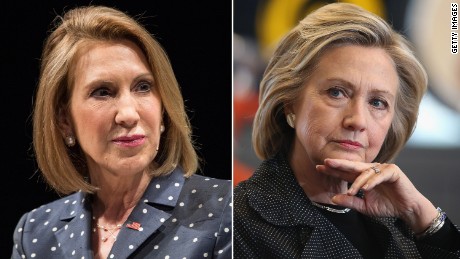
Taking a look at this election cycle, as well as the 2012 election season, Hillary Clinton, Carly
Fiorina, and Michelle Bachmann all hit or are hitting up against a glass ceiling.

I think it's fair to say that all three of these women's leadership styles all include an element of brusqueness. Additionally, I think it's fair to say that all three women are very passionate about their core issues and about the business of trying to lead America. As a result, that brusqueness comes out during policy speeches, town halls, debates, and rallies.

Enter the double-standard. My observations show a remarkably different take that we have with men still. If a man does not illustrate a certain level of sternness, he is deemed weak and therefore unworthy of the office of President. Mr. Trump's appeal, as well as the appeal of so many other men in both parties across many years of political races is based on a perception of strength.

It does not take long to find a 'Comments' section or a tweet that has something to the effect of 'Wow, she's being a real [insert flowery expletive here].'. Yet, if a male candidate took the opposing posture, we would be saying 'Jeb Bush just looks so soft'. Well, the truth is that many do say that. If Mrs. Fiorina, Secretary Clinton, or Mrs. Bachmann took a much softer stance, then they would simply go unnoticed and would be largely patronized by their competitors and the media throughout the election.

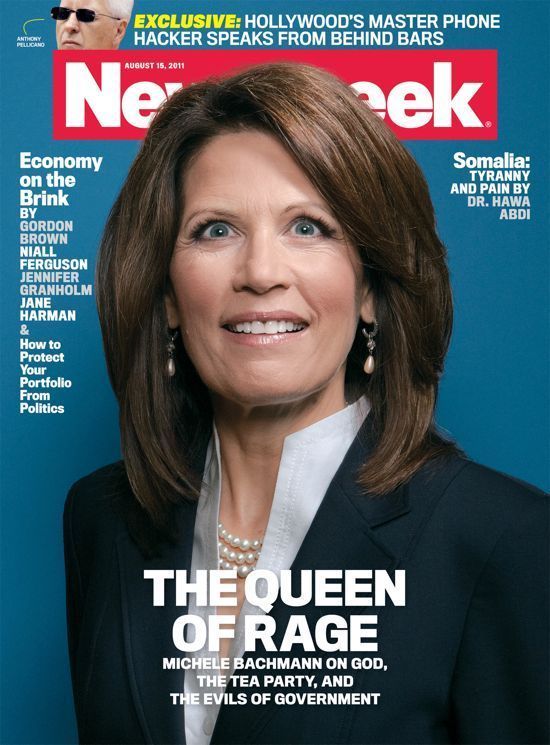
Going back to 2012, Mrs. Bachmann certainly was known to take very firm stances on a common conservative issues. Her more aggressive posture was also capitalized by being at the forefront of the rising Tea Party Movement. Let's not forget the Newsweek magazine front cover, which labelled Mrs. Bachmann as the 'Queen of Rage' and posted a non-flattering photo across the entire page. It certainly disrupt the campaign, since it came so early in the campaign, but it was arguably a contributing tone-setter to the electorate's perceptions of the congresswoman from Minnesota.

Even when these candidates are not speaking at the podium, they are often being judged by their looks. It's insane to have read that the posture of these candidates can be categorized as 'RBF', but it's just Mr. Trump or Senator Cruz relaxing in between questions.

For all of the progress that we have made, America just is not there yet and the cultural swing in that direction might not be complete by November. I remember Senator Bernie Sanders saying this during a town hall recently, and I am still surprised this did not make more headlines. He was asked if he felt that America has made more progress in gender or racial equality.He actually responded that we have made greater strides in racial equality, which might be abundantly surprising to some still in the wake of Freddie Gray and Ferguson. Still, Senator Sanders might be on to something here. After all, as he cited, 'we elected an African-American to the White House', but we still have yet to take the next step to push for a woman.

This all being said, proportionally men dominate the political scene and therefore there is a greater statistical likelihood of a male-dominated field and a man consistently getting these opportunities. That is still an issue that needs to be examined and figured out, but, then again, maybe the right woman has yet to enter the scene. Ultimately, we should not elect a woman just for the sake of achieving a milestone, but I would like to see a woman in the White House and see her continue to put our country in a position to thrive.

So, does it not better suit these candidates to take the risk of coming off as brusque and giving it all they can in this race?

Unfortunately, it's a damned if you do, damned if you don't 'Catch 22' type of situation.